
Introduction
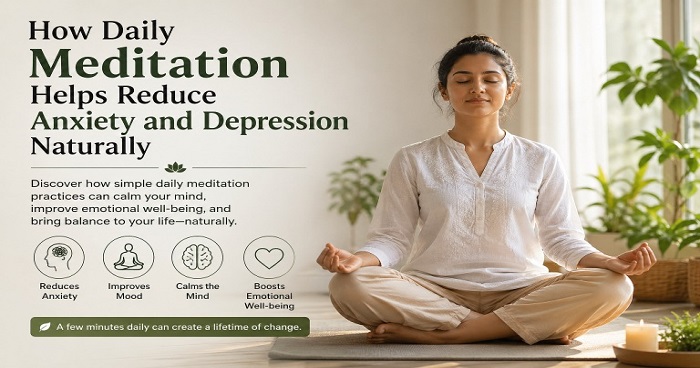
Daily meditation for anxiety and depression is a simple yet powerful way to restore emotional balance and improve mental well-being. In a world that rarely pauses, the mind often carries more than it can process. Anxiety, overthinking, emotional fatigue; these have quietly become part of everyday life.
For many, the struggle is not just external pressure, but an inner restlessness that does not easily settle.
Meditation offers a simple, natural way to begin restoring balance. It does not require dramatic change, only a few moments of stillness, practiced consistently.
Across mental health and wellness spaces, meditation is now widely recognized as a powerful tool to support emotional well-being. Organizations such as AnuAggarwalFoundation integrate meditation and mindfulness practices into programs that support both stress relief and deeper emotional healing.
Meditation for mental health is increasingly being recognized as a simple yet powerful approach to managing stress, anxiety, and emotional imbalance. While modern life continues to accelerate, practices like meditation offer a way to slow down, reconnect, and build inner stability without relying on external solutions.
Practicing daily meditation for anxiety and depression helps calm mental noise and restore emotional clarity.
Understanding Anxiety and Emotional Imbalance
Anxiety is not always caused by one clear reason. It often builds gradually, from stress, unresolved emotions, or constant mental activity.
Common experiences include:
- Racing thoughts
- Difficulty focusing
- Restlessness or unease
- Emotional highs and lows
- Sleep disturbances
Depression, similarly, can manifest as:
- Low energy
- Lack of motivation
- Emotional numbness
- Withdrawal from daily life
While these experiences vary from person to person, they often share a common root: a mind that has lost its natural balance.
What Is Meditation?
Meditation is the practice of bringing awareness inward; observing thoughts, breath, and sensations without judgment.
It is not about stopping thoughts.
It is about changing the relationship with them.
Through meditation, the mind gradually shifts from:
- Reaction → Observation
- Chaos → Clarity
- Tension → Ease
This shift is subtle, but deeply transformative.
In the context of mental health, meditation is not just a relaxation technique but a long-term practice that helps regulate thoughts, emotions, and behavioral responses. This makes it especially valuable for individuals seeking natural ways to support their mental well-being.
How Meditation Supports Mental Health
Meditation works directly with the nervous system and the mind.
- Calms the nervous system
Slow breathing and stillness reduce the body’s stress response, helping it move out of constant alert mode. - Reduces overthinking
By observing thoughts rather than engaging with them, mental noise begins to settle. - Improves emotional awareness
Meditation creates space to notice emotions without being overwhelmed. - Builds resilience
Over time, regular practice strengthens the ability to handle stress with greater stability.
These effects make meditation a powerful support for those experiencing anxiety, emotional imbalance, or low mood.
This is why daily meditation for anxiety and depression is widely recommended as a natural approach to improving mental health and emotional stability.
Because of these benefits, meditation for mental health is often recommended by wellness practitioners as a complementary approach alongside other forms of emotional support and therapy. It works gently, yet consistently, to restore balance within the mind and body.
This is why meditation for mental health is considered a foundational practice in long-term emotional well-being.
Meditation vs Other Stress Relief Methods
Unlike temporary stress relief methods such as distraction, entertainment, or avoidance, meditation addresses the root cause of mental unrest. While other methods may offer short-term relief, meditation builds long-term emotional resilience by changing how the mind responds to stress. This makes it a sustainable and holistic approach to mental wellness.
Meditation and Trauma Healing
For some individuals, anxiety and emotional distress are linked to deeper, unresolved experiences.
Meditation, when practiced gently, can support trauma healing programs by:
- Reconnecting individuals with their breath and body
- Creating a sense of safety in the present moment
- Reducing heightened emotional responses
It is important that meditation in this context is approached with care and awareness, often alongside supportive practices.
Healing is not forced; it unfolds gradually.
Simple Daily Meditation Practices
Meditation does not have to be complex. Even a few minutes daily can create meaningful change.
Daily meditation for anxiety and depression becomes more effective when practiced consistently, even if the duration is short.
- Breath Awareness
Sit comfortably and focus on your breath.
Notice each inhale and exhale.
When the mind wanders, gently return to the breath.
- Body Awareness Meditation
Bring attention to different parts of the body.
Notice sensations without trying to change them.
This helps release stored tension.
- Guided Meditation
Listening to a calm voice guiding your awareness can be helpful, especially for beginners.
- Mindfulness in Daily Life
Meditation is not limited to sitting still.
It can be practiced while walking, eating, or even during simple daily tasks.
This connects closely with mindfulness for stress relief, where awareness becomes part of everyday living.
For those beginning their journey, meditation for mental health does not require perfection or long hours of practice. What matters most is consistency and a willingness to observe the mind without judgment. Even small daily efforts can create noticeable shifts over time.
Role of Daily Meditation for Anxiety and Depression
Daily meditation plays a key role in meditation for mental health by creating consistency. While occasional practice offers temporary relief, regular meditation builds long-term emotional stability and reduces recurring anxiety and depressive patterns.
Building a Consistent Practice
Consistency matters more than duration.
Start with:
- 5–10 minutes daily
- A quiet, comfortable space
- A fixed time (morning or evening)
Over time, meditation becomes less of an effort and more of a natural state.
The Link to Holistic Mental Wellness
Meditation is often part of broader holistic mental wellness programs, which combine:
- Breathwork
- Yoga
- Emotional awareness
- Lifestyle balance
This integrated approach supports long-term mental and emotional well-being rather than temporary relief.
Experts recommend daily meditation for anxiety and depression because consistency strengthens emotional resilience over time.
FAQs
1. How does meditation support mental health?
Meditation helps calm the nervous system, reduce overthinking, and improve emotional awareness, making it easier to manage stress and anxiety.
2. Can meditation help with anxiety and stress?
Yes, regular meditation can reduce symptoms of anxiety by helping the mind shift from constant reaction to calm observation.
3. How long should I meditate daily for mental health benefits?
Even 5–10 minutes daily can be effective when practiced consistently. Over time, the duration can be increased naturally.
4. Is meditation a replacement for therapy?
Meditation is a supportive practice, not a replacement for professional therapy. It works best as part of a holistic mental wellness approach.
Conclusion
Meditation is not a quick fix. It is a quiet process of returning to balance.
With regular practice, the mind begins to settle. Anxiety softens. Emotional clarity improves.
What once felt overwhelming becomes manageable.
And slowly, almost without effort, a sense of calm begins to take root.
To explore structured programs and guided practices, you can also visit the meditation and mental wellness initiatives offered by Anu Aggarwal Foundation.
With regular practice, daily meditation for anxiety and depression can gradually transform how the mind responds to stress and emotional challenges.
A regular routine of daily meditation for anxiety and depression creates lasting mental balance.
Because sometimes, the most powerful shift is not in doing more, but in learning how to be still