
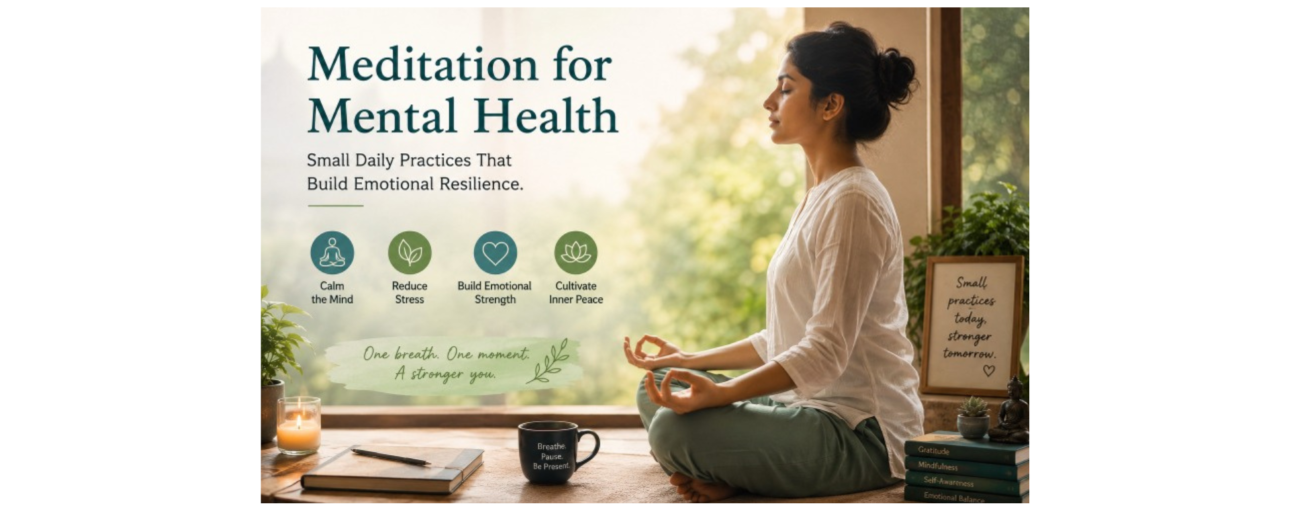
Meditation for Mental Health is one of the most effective daily practices for building emotional resilience and improving overall well-being. Mental health isn’t simply about avoiding stress. It’s about developing the inner capacity to meet life’s challenges without losing ourselves in them. That is where meditation becomes more than a relaxation technique-it becomes a daily practice of emotional resilience.
Life doesn’t usually overwhelm us all at once. More often, it arrives quietly-through unread messages, difficult conversations, endless deadlines, family responsibilities, and the constant pressure to keep going. Over time, our minds become crowded, our bodies tense, and even moments of joy begin to feel distant.
Mental health isn’t simply about avoiding stress. It’s about developing the inner capacity to meet life’s challenges without losing ourselves in them. That is where meditation becomes more than a relaxation technique-it becomes a daily practice of emotional resilience.
Emotional resilience is built, not born
Many people believe resilience is a personality trait. In reality, it is a skill that grows through consistent habits.
Regular Meditation for Mental Health helps strengthen emotional awareness, reduce stress, and improve the ability to respond calmly during challenging situations.
Just as physical exercise strengthens muscles, meditation strengthens our ability to pause before reacting, recover after setbacks, and return to a place of balance. A few minutes of intentional awareness each day can gradually change how we respond to pressure, disappointment, and uncertainty.
The goal isn’t to stop thoughts. The goal is to develop a healthier relationship with them.
Small practices create lasting change
Meditation doesn’t require an hour of silence or a perfect environment. It begins with small moments of awareness woven into everyday life.
Even a few minutes of Meditation for Mental Health each day can improve focus, emotional balance, and long-term mental wellness.
Simple practices include:
- Taking five slow breaths before starting work.
- Sitting quietly for five minutes each morning.
- Practising gratitude before going to sleep.
- Pausing to notice your emotions without judging them.
- Bringing your attention back to your breath whenever your mind feels overwhelmed.
These small habits gently train the nervous system to move from constant reactivity toward calm awareness.
Why consistency matters more than duration
Many people give up because they believe they aren’t meditating “correctly.”
There is no perfect meditation.
Five minutes practised every day is often more transformative than one hour practised once a week. Emotional resilience develops through repetition, not intensity.
Each practice becomes a reminder that calm is not something we search for outside ourselves. It is something we learn to return to.
Meditation in everyday life
Meditation is not limited to sitting with closed eyes.
Making Meditation for Mental Health part of your daily routine encourages a calmer mind, healthier emotional responses, and greater resilience over time.
It can be practised while walking, waiting in traffic, drinking a cup of tea, listening deeply to another person, or simply noticing your breathing during a busy day.
The more mindfulness enters ordinary moments, the less stress controls extraordinary ones.
The AnuFunYoga Program by the Anu Aggarwal Foundation combines meditation, mindful movement, conscious breathing, and self-awareness practices to support emotional and mental well-being. Designed to help individuals manage stress, improve focus, and build emotional resilience, the program encourages simple daily habits that promote long-term inner balance. By integrating Meditation for Mental Health with holistic wellness practices, AnuFunYoga empowers people to cultivate a calmer mind and a healthier, more resilient lifestyle.
A gentle invitation
Mental wellbeing grows through small daily choices.
One conscious breath.
One quiet pause.
One moment of gratitude.
These simple practices may seem small today, but over weeks and months they build something remarkable-an inner steadiness that allows us to meet life with greater clarity, compassion, and resilience.
The benefits of Meditation for Mental Health become stronger with consistency, helping individuals develop lasting emotional strength and inner peace.
Meditation is not an escape from life.
It is a way of becoming fully present for it.
The Anu Aggarwal Foundation believes emotional wellbeing begins with simple, sustainable daily practices that help individuals build resilience, self-awareness, and a healthier relationship with their minds.
Conclusion
Meditation for Mental Health is not about achieving perfection or eliminating every stressful thought. It is about creating small, consistent moments of awareness that strengthen emotional resilience over time. By making meditation a part of your daily routine, you can develop greater self-awareness, manage stress more effectively, and build a healthier relationship with your thoughts and emotions. At the Anu Aggarwal Foundation, we believe that lasting mental well-being begins with simple, mindful practices that empower individuals to live with greater clarity, balance, and inner strength.
Ready to improve your emotional well-being through Meditation for Mental Health? Contact the Anu Aggarwal Foundation today to explore our mindfulness, yoga, and wellness programs designed to build resilience and inner balance.
FAQs
1. What is Meditation for Mental Health?
Meditation for Mental Health is the practice of using mindfulness, focused breathing, or guided meditation to reduce stress, improve emotional well-being, enhance self-awareness, and build resilience against daily challenges.
2. How long should I meditate each day for better mental health?
Even 5–10 minutes of daily meditation can provide significant mental health benefits. Consistency is more important than the duration, and regular practice helps create lasting positive changes.
3. Can meditation help reduce stress and anxiety?
Yes. Meditation helps calm the mind, regulate emotions, and reduce the body’s stress response. Regular practice can lower anxiety levels, improve focus, and promote a greater sense of inner peace.
4. Is Meditation for Mental Health suitable for beginners?
Absolutely. Beginners can start with simple breathing exercises or short guided meditation sessions. There is no right or wrong way to begin—small, consistent steps lead to meaningful results.
5. How does the Anu Aggarwal Foundation support mental well-being?
The Anu Aggarwal Foundation promotes holistic mental wellness through mindfulness, yoga, emotional resilience programs, and community initiatives that encourage self-awareness, stress management, and healthier lifestyles.